Automotive Software Testing: From Fundamentals to HIL Validation (Coming Soon)
Uncategorized
Wishlist Share
Share Course
Page Link
Share On Social Media

About Course

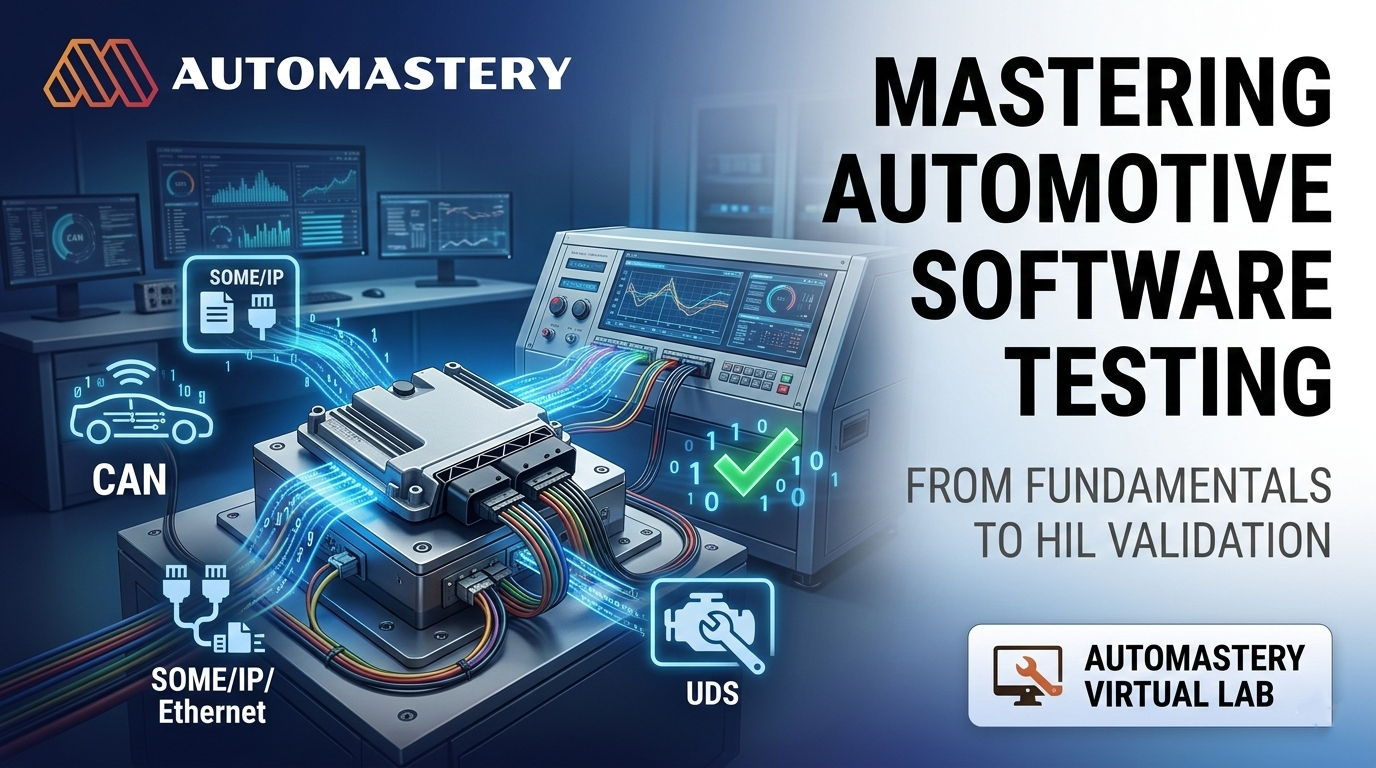
Welcome to “Mastering Automotive Software Testing,” your comprehensive guide to becoming a job-ready Automotive Test Architect. The automotive industry is rapidly transitioning into the era of Software-Defined Vehicles (SDVs), making software validation the most critical stage of vehicle development. This course bridges the gap between academic theory and enterprise-level industry demands. You will learn the intricacies of testing vehicle Electronic Control Units (ECUs), simulating networks with Rest Bus Simulation (RBS), and validating software using industry-standard protocols like CAN, UDS, and Automotive Ethernet. Designed for enthusiasts, software testers, and engineers eager to build a high-paying career in modern automotive testing.

What Will You Learn?

  • Automotive Testing Fundamentals:
  • Gain a solid foundation in the V-Model, Automotive SPICE (ASPICE), and ISTQB principles tailored specifically for automotive software (CTFL-AuT).
  • Network Protocols Demystified:
  • Master the backbone of vehicle communication, from classic CAN and CAN-FD to cutting-edge Automotive Ethernet and SOME/IP.
  • Rest Bus Simulation (RBS):
  • Learn how to simulate missing vehicle nodes (virtual ECUs) to test individual components in isolation without needing a full physical car.
  • Diagnostic Testing (UDS & DoIP):
  • Discover how to test vehicle diagnostics using ISO 14229 Unified Diagnostic Services, including reading/clearing DTCs and routine controls.
  • Testing Environments Explained:
  • Clearly differentiate between Model-in-the-Loop (MIL), Software-in-the-Loop (SIL), and Hardware-in-the-Loop (HIL) testing phases.
  • Hands-on HIL Validation:
  • Explore the architecture of physical HIL test benches, learning how fault injection, load simulation, and signal conditioning work in reality.
  • Introduction to Test Automation:
  • Transition from manual testing to automated workflows, understanding how scripts (like CAPL) are used to simulate network interactions and generate pass/fail reports.
  • Enterprise Engineering Workflows:
  • Gain familiarity with the Agile tools and methodologies used by top OEMs (like BMW and Tesla), including JIRA and GitHub for issue tracking.

Student Ratings & Reviews

No Review Yet
No Review Yet